The wind blows fiercely for most of the day. Our home is set atop a hill, overlooking the blue bay of platys gialos. The olive trees in the terraced orchard below, shiver in the gusts and we can see white surf break through in the blue sea below. Even the sunlight seems different. Gone is the white cloudless glare. Low clouds move quickly over the hills and the sun shines through in brief spells. We entertain Arjun with Legos and the two resident cats drink copious amounts of milk from a beautiful ceramic ashtray.
Our wonderfully kind host at our temporary home brings a wooden tray with a beautiful feast. There is of course the famous chickpea soup, revithada, sloshing about in a spouted ceramic kettle, cooked in a wood-fired oven for a whole 24 hours. It has to be the tastiest non-meaty stuff I have ever eaten. Then we have a really hard brown crunchy bread and large black olives from the orchard that sits below us. Revithodefkes (falafel in these parts) and a sublime honey cheesecake called melopitas complete the treat.

We have enough food for several meals. The generosity of our hosts is beyond belief.
At night, we see blue and red lights flashing from the bay below. Safe in our warm sofas we, we imagine that this is perhaps a rescue mission that’s out to bring ashore the passengers of a sailboat in distress. The wind is howling and the gusts have been clocked at highway speeds. What else could these flashing red and blue lights mean?
Until a few hundred years, pirates tossed about in these waters. Life was not always about honey cheesecakes. In the Middle Ages, Saracens (a catch-all term for Arab and Turk Muslims) would raid the Cycladic islands and terrorize the inhabitants.
The settlement of Kastro, the old capital of Sifnos is built fortress-style atop a hill overlooking the bay. You enter through narrow arches and the claustrophobic mazelike alleys, now whitewashed and home to chic tavernas, once served as defenses against the barbarians. There are tiny ledges, that run over the narrow cobbled paths. Perhaps, the inhabitants poured hot oil over any unpleasant intruders. Roman pillars are causally incorporated into the homes, and I feel that history runs deep here.

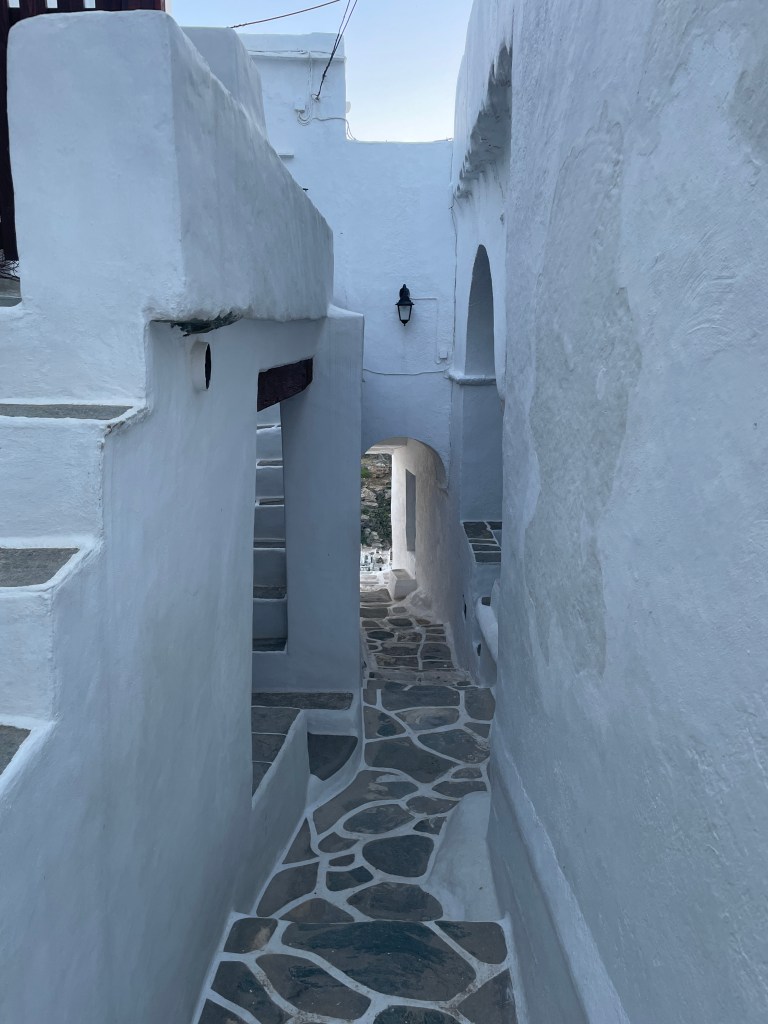

When practical defensive engineering failed, there were miracles. We see one at the beautiful chapel at Chrissopiggi. We approach it from the beach at Faros, and after a short walk that runs along a cliff, we see a bright white chapel, surprisingly without a blue dome. It sits on a tongue of rock that sticks out into the sea. The miracle is the gash that opened up, in this sliver of rock. The good women of Sifnos were fleeing the pirates and took shelter in the church. Lo and behold when the ugly pirates showed up, the rock opened up and the pirates could not make the leap across. Today a short bridge over a stone arch takes us over this gap and pretty purple sea figs line the sedimentary rocks.


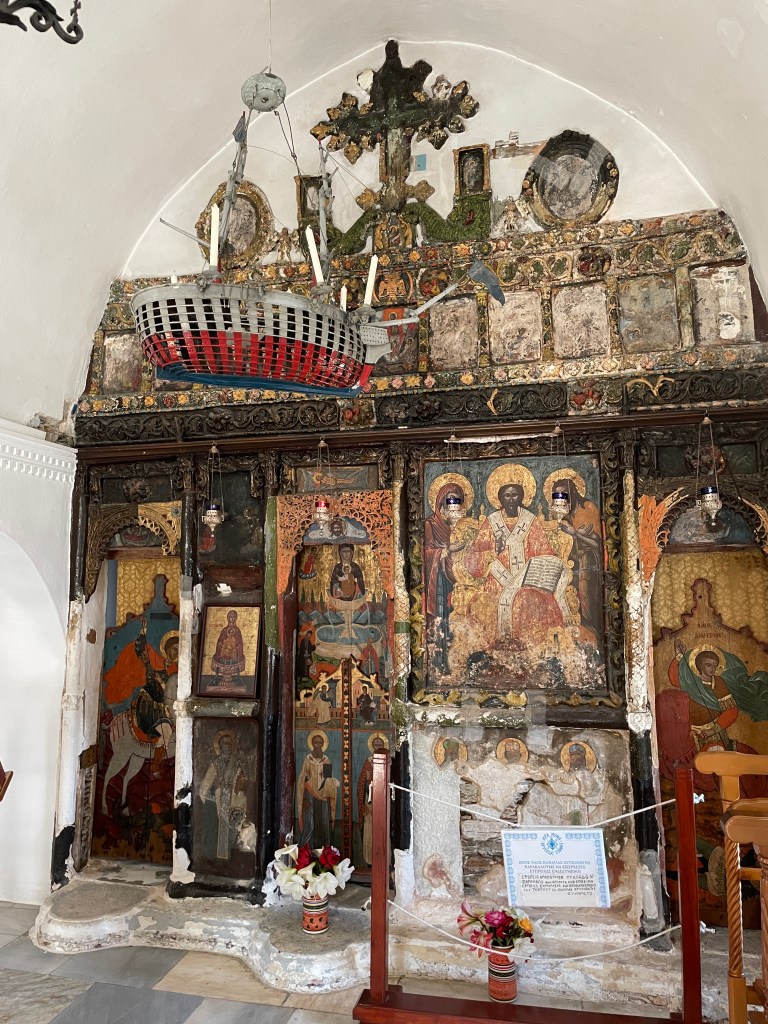
Arjun gets down to polishing a marble stone, we picked up on the trail. A little labour and we have fine marble powder that flies off in the wind. Dhanya, like the ladies of ancient sifnos seeks refuge in the chapel from the wind. Inside there are decidedly medieval-looking paintings on wooden boards. The altar has a hanging metal ship. One hopes, this is for the Christian pirates.
Pirate attacks are a running theme in Sifnos. Go back a few thousand years and the sifnians were besieged by the folks from the island of Samos, who were in the midst of a war with their Athenian neighbors. War in the Aegean islands was a rather common occurence. The Samians asked the Sifnians for money to fund the war chest and when the Sifnians refused, much plunder and destruction ensued.
The sifnians didn’t give up. They built stone towers to better watch the seas. After two and a half thousand years the remains of the ancient watch towers make for an interesting detour. We try to locate the so-called “black tower” and show internet images to school girls returning home. We are supposedly where Google Maps, thinks the towers are. The kids, probably happy to be done with the tedium of school, giggle and claim to have never seen the pile of black rock. Who cares for history when young anyway?
After clambering over a fence and trespassing over a field of hay, we finally see the “black tower”. Only the base survives. Huge grey rocks, wind weathered line the bottom. Without apparent mortar, the ancients piled on more rocks and built these towers. Even today, the moderns build stone walls without mortar. Orange lichen provides the aesthetic glue, magically holding the whole thing up.


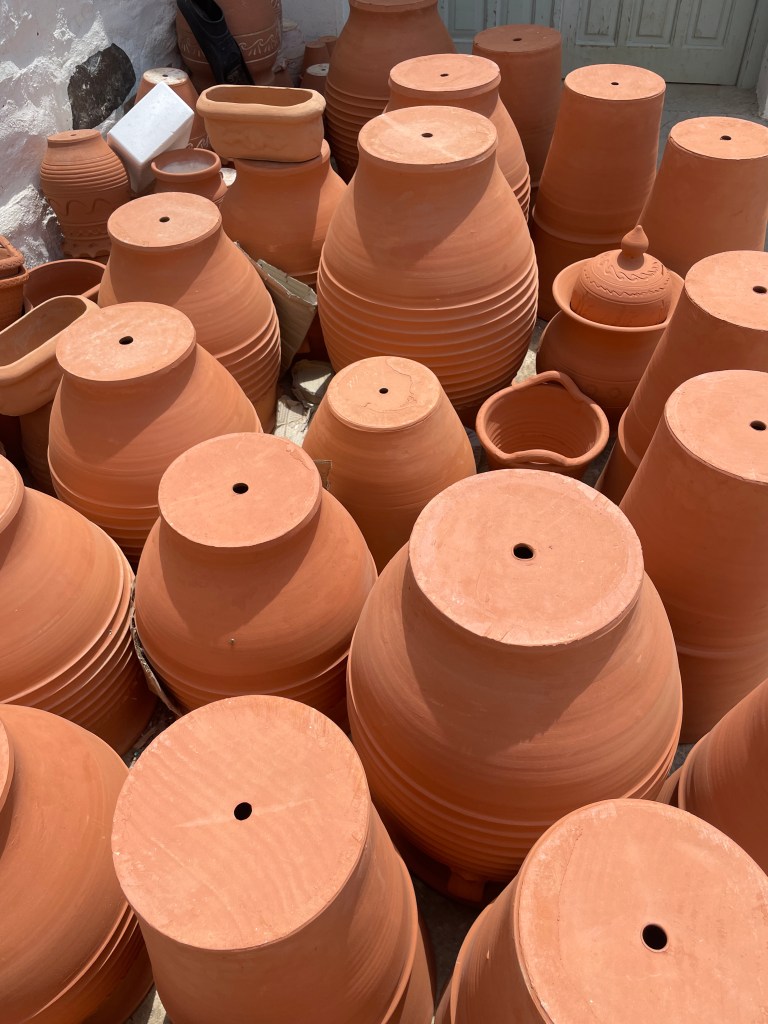
Why did the islanders become aesthetes? How is it that even a mundane ashtray becomes a ceramic piece of art here when in the barbarian mainlands people make do with aluminum ugliness? Giorgios a ceramic artist who runs a studio, on the way to the small settlement of Xerronisos, does not have an answer. He sits astride a spinning potter’s wheel, angled rather uncomfortably and the discs of wet clay, that shear off cleanly with a wire tool mesmerizes Arjun who stares as if in a trance. Outside, beautiful pots dry in the sun. The Cycladic law mandates that there be a friendly kitten.

Sifnos seems to demand a deeper exploration. One afternoon, we meet Sharon and Jim , who travel from distant Canada and are frequent visitors to Sifnos. I learn a lot from Sharon’s wonderful blog and she is now working on her third book on Sifnos ! Jim’s black and white photographs are just what the sifnian aesthetic demands. I’m lucky to get an autographed copy of her first book.

Our first hike on the island takes us to a Mycenean citadel. It is still springtime here and we walk past red poppies and a sinister-looking large purple Arum. The Myceneans were the original ancients (not counting the stone agers). Three thousand years ago, a good thousand years before the “Classical Greeks”, they dug for metals and smelted ore. They built this citadel, of which only a stubby wall remains.
Nostalgia runs deep here and why not ? The sifnians have great food, handsome homes, stunning pottery and generous people. Even the tourist magazines have black and white pictures from the past. We all wish we were sifnians.

 Three Bears Travel
thank you again for transporting me to my beloved island.
a wonderful place but mostly for transients.
life for the locals is not easy.
if you find them read “100 days in sifnos” by daphne kapsali
or “my house in sifnos “by christian brechneff ( not sure about the names of the books or the spellling of the author names)
in recent years the population of the island has diminished.
agriculture is down. fishing is almost non existing.
they rely on tourism which, alas , is very short period.
with this income they have to do through the harsh winter.
they have to bring almost everything from the mainland using ferry service. which is nor reliable in winter.
for medical treatment the need to use an helicopter.
still, as you felt , they are warm , friendly generous people.
keep writing , i love it
WordPress.com / Gravatar.com credentials can be used.
LikeLiked by 1 person
Dear yakir, I must thank you sincerely for your thought provoking note. Indeed you are right about the hardships the islanders face. As tourists, we tend to focus on the pleasant and enjoyable and don’t dwell too much the other side. But you are absolutely right. Tourism which is probably only in the warmer months, is a funny thing. Water too has to be shipped in. Trash has to be shipped out. I think I saw a landfill on the road to Xeronissos. I hope to visit in the fall or winter some time and learn more about sifnos. Thank you for the book recommendations. I will look them up.
Cheers and thanks once more for your meaningful comment.
LikeLike
You’ve done it again. Your words so capture the warmth that is Sifnos. As Yakir rightly points out, they’ve endured so much now as they have over the millennia, and yet their goodheartedness is what prevails.
LikeLiked by 1 person
Thank you so much for the encouraging words ! Like you found out, I think sifnos demands a lot of repeat visits to get to know the people and landscape better. There is so much to learn
LikeLike
i would love to show you israel but right now is not a good time.
i hope it would became livable again in the near future
LikeLike
I hope peace returns to israel soon. I will take you up on your offer soon 🙂
LikeLike