Madaba has been cool and wet this week. The rain comes down as we sit down for a tasty lunch of mansaf and other assorted delicacies. Quickly the street outside becomes a wide gushing torrent. We order some delicious khunafa and sip on cardamom infused arabic coffee, steeling ourselves for the challenge of keeping the little toddler engaged indoors.
The next day we drive downhill along a winding road cutting across the mountains. Legend says that Moses saw a glimpse of the promised land from atop Mount Nebo and is reportedly buried around these parts. Now flocks of sheep graze placidly on the slopes, watched by a young bedouin boy. The bedouin live in a small camp of sturdy plastic tents with a few pickup trucks. Some children are playing with a ball.

The road flattens out as we drive over a great depression in the earth’s crust. We are at the edge of the Dead sea. The Arabian and African continental plates are diverging and the crust in between sinks. What was once a small bay of the mediterranean sea, became a landlocked lake about two million years ago, when the land to the west heaved up.
A turquoise sheet of water is below us. It stretches all the way to what is possibly the most contested land anywhere on Earth. Across the blue haze lies Palestine or the “West Bank”. On the map, it’s marked by dotted lines, its existence a question. Move your gaze a little, either to the left or the right and the map marks Israel with bold solid lines. Standing here on the Jordanian edge of the Dead sea, it all looks uniformly sandy brown. People on the opposite edge take a much more rigorous view of the boundaries. The promised land turned out to be quite messy.
I wonder where all the gushing torrents of Madaba from yesterday have drained. Not much of it seems to have found its way down here. We are 1400 feet below sea level, the lowest elevation on the Earth’s surface. For a moment I wonder how exactly sea level is defined . It’s a bit strange that we are below sea level when I can still see the shimmering blue of the dead sea below me.
A breeze blows and we inhale the air, heavy with excess oxygen. The cool air of Madaba seems far away now.

We clamber down a rough trail where a few entrepreneurial Bedouins have set up little ramshackle showering arrangements. The dead sea is evaporating fast. Every year the water level drops by about 4 feet and everyone needs to walk down a bit further to reach the waters. Plastic water drums high up on the hillside provide water to wash away after a swim in the briny sea. Google map, rather dourly simply calls this place “Dead Sea free swimming”.


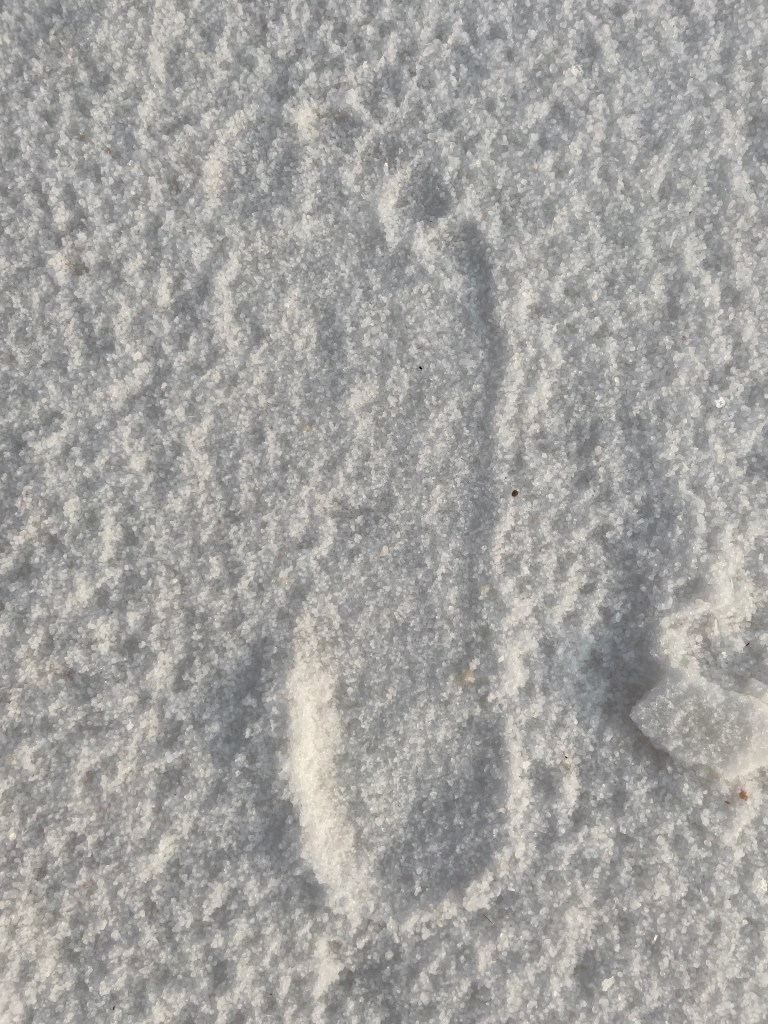
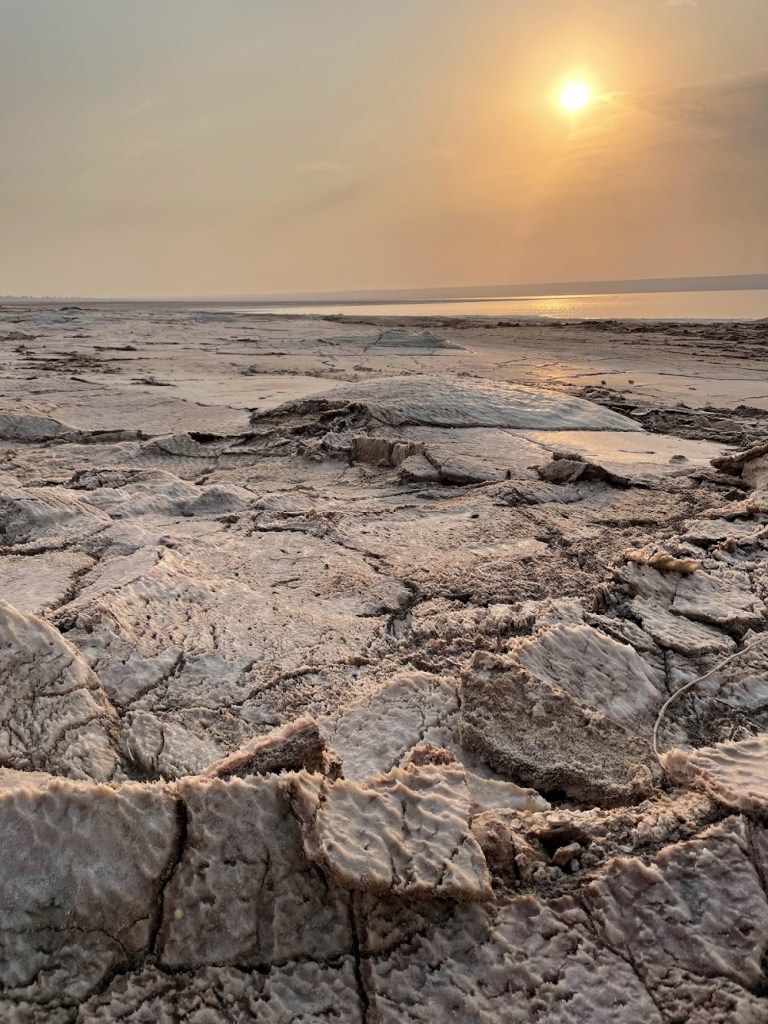
We ditch our “land clothes” and get into dorky swimwear. Gentle waves roll over beautiful salt crystal corals. The salt grows in wafer like sheets and is crunchy to walk on. Elsewhere the crystals are sharp and spiny and walking barefoot over them is not for the sensitive. Arjun quickly discovers that the water is so salty that it stings. He goes back to the shore and discovers the simple pleasures of blasting a siren from his newly acquired police truck. A Jordanian lady, who is chaperoning a group of young adults from Amman is understanding and smiles at him.


The dead sea is one third salt. We start feeling the tingling around our shins after a minute. An oily film floats on the surface. There are all sorts of exotic salts floating in this water. There is an unusually high level of Magnesium, potassium and bromine. I dip my fingers and taste it. Bitter and salty. I’m wondering how to start floating. We enter a bit deeper and flop on our backs. It’s surreal. The water pushes my bum and I can raise my toes into the air. Quickly we get the hang of it and we are doing languid backstrokes and taking it all in. Swimming face down is a recipe for pain. The exotic salty water stings your eyes like some biblical curse. The worst part is you cant see much once there is that much salt in your eyes, your eyelids close automatically over the stinging. You wait and blink tears of salt and soon your eyes do get back to normal.

We marinate in the sea and do lazy flips. I try to stand up straight and accidentally discover an ungainly technique to roll over on your belly. It’s probably some strange physics involving specific densities and center of gravity, but I can confirm that it’s not possible to walk on the dead sea. Jesus who was baptized nearby on the Jordanian side of the sea, must have done his fabled stunt somewhere else.

It’s fun to look towards the far side and watch the horizon. It’s a shimmering light blue. The bedouins who man the rough and ready shower stalls provide buckets of the famed dead sea clay. I leave the water and rub the sticky black clay all over hoping to cure some itches. The clay dries off soon in the heat and we enter the salty waters again to wash it off. This time I am more confident and swim a bit further out. The blue of the horizon blends with the waterline .
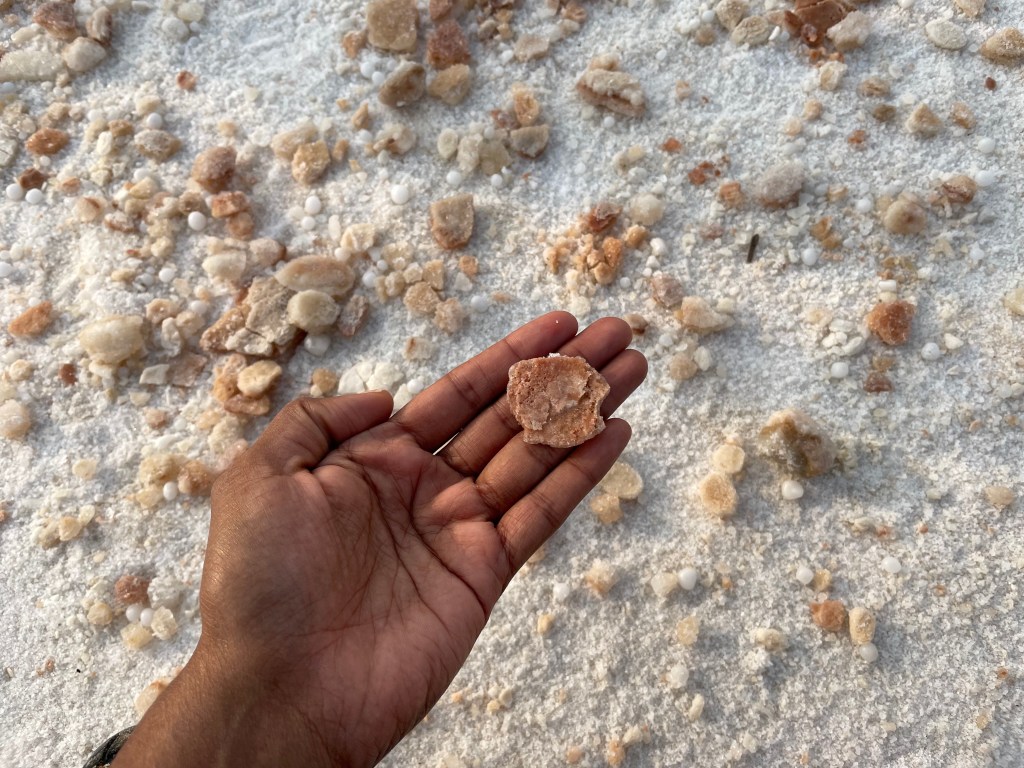

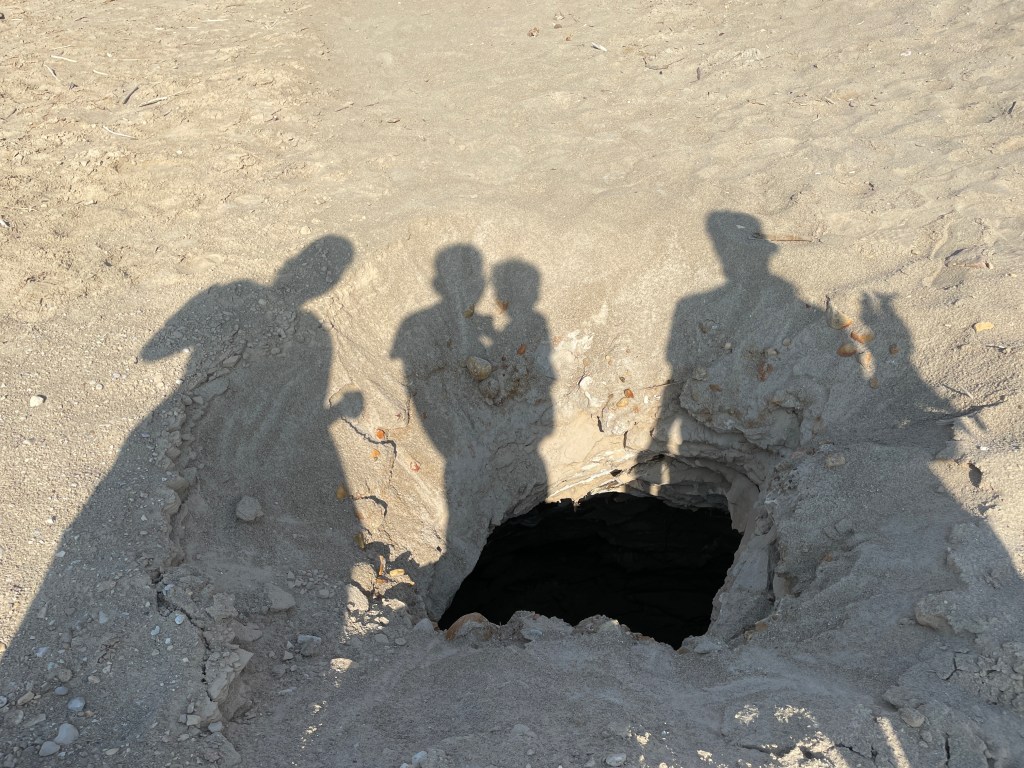
Jordan is a small country and it seems the dead sea is always near. We make several forays into the dead sea. From Kerak, we go to another of the free swimming spots. This one is called salt beach, and to get to it, we have to walk down a fairly steep crumbling path. We cautiously peep into some gaping sink holes. One never knows what can be found here. On a similar shore on the Palestinian side, a young herder found the famous dead sea scrolls, tucked away in a small hole. Both the Biblical and conspiracy theory types, derived much entertainment from these parched fragments. Alas, we don’t make any such discoveries.
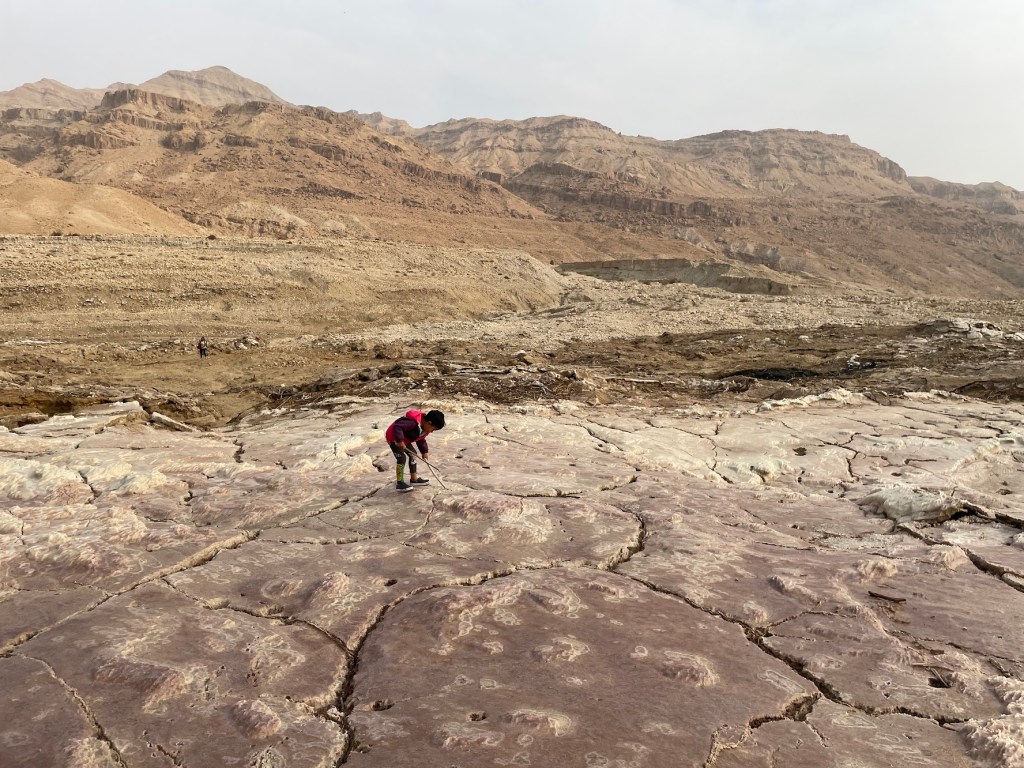
We walk along huge slabs of pinkish crusty salt and enjoy another swim. I’ve begun to love these briny soakings. We are the only souls here. Perhaps, the sharp gradient and the long walk mean that most people prefer to experience the dead sea in the more expensive resorts, where golf carts can ferry you to the water’s edge.
We return to this spot with my parents who bravely take on the treacherous hike down. The wind blows stiffly and the waves rise and splash. What was a gentle calm lake a few days back is now a rough splash of salt. It’s a tough initiation for my parents into the dead sea. Dhanya almost gets swept away by the current and stays calm to paddle back to the shore. Although it’s impossible to sink in the dead sea, bad things can happen if you end up swallowing a lot of the briny water. The stiff winds and current have led to folks being blown off to the Israeli side.

Driving along the highway that runs parallel to the dead sea, we pass small farming towns. Pickup trucks are overflowing with carrots and other green leafy vegetables. The sandy desert is apparently very fertile, if only watered. Environmentalists blame the subsidized irrigation for the fast evaporation of the dead sea. Apparently you can’t have your carrots and therapeutic soaks in the dead sea together. You must choose one. Or just enjoy both with a few guilty sighs.

The Israelis over yonder dealt with the declining water levels along the big resorts by simply creating artificial pools where continuously running pumps, float the unweary resort tourists. The company that runs these “pools” is called the Dead Sea Works. Engineering solves most problems !

Thankfully in Jordan, its still possible to enjoy a more natural experience. Our last foray into the dead sea is “resort style”. We trade a bit of natural wildness for paved paths and german shower fittings.
The Dead sea is relaxing and also menacing in its potency. On some days it is benign and on others it can be tempestuous. Once a host who we asked for directions looked alarmed and asked ‘Why do you want to go there?’ and the locals themselves prefer the hot springs nearby at Ma’in. Perhaps this is an experience the tourists enjoy more than the locals.
 Three Bears Travel
Visited The Dead Sea in Israel. It’s an eerie and unique experience. Also spent time in a Bedouin village. Wonderful photos. Really enjoying your adventures and sharing of your journey.
LikeLike
Thank you avigail ! The dead sea is truly awesome . Happy travels to you too.
LikeLiked by 1 person