After a delicious lunch of grilled snapper, we set off for the Acropolis. From our street, we can see the ancient fortess perched atop the hill and we find ourselves on a broad paved path that skirts the north slope. A talented street musician plays the harmonica, strums the guitar and bangs an improvised drum, all the while singing folksy tunes.
We stop at the Greek Orthodox church of Saint Sophia. A truly heavenly smell of incense wafts across the tiny church and Arjun is enticed to come in. After months of seeing roman catholic churches in Iberia, the differences stand out. There is a magical 2 headed bird on the tiled floor and to my untrained eye, the face of Jesus christ appears a little greek. There is no heavy gilding and the alter is rather simple. Arjun, makes himself comfortable on a small polished wooden chair.


We continue along the paved avenue and arrive at the Northern slopes. Olive trees grow abundantly and a mediterranean tortoise lumbers in the shade. The steps that climb to the Acropolis, are marble and worn down to a silky smooth texture.
The Acropolis hill, is a 100 million years old Cretaceous limestone deposit that in an unusual geological twist, sits atop a younger layer of bedrock, called the Athens schist. I can see large crumbly limestone boulders and perhaps some reddish smooth sandstone outcrops. The marble that was used to build the monuments came from a the Pentellic mountains 10 miles away.
The Athenians had just repelled their traditional enemies, the Persians in 460 BC. The Persians, had smashed a lot of the earlier monuments at the Acropolis and the Greeks commenced on a grand rebuilding program. A hundred years later, when Alexander would defeat the Persian Darius, he adorned the Parthenon with shields of the defeated Persians.

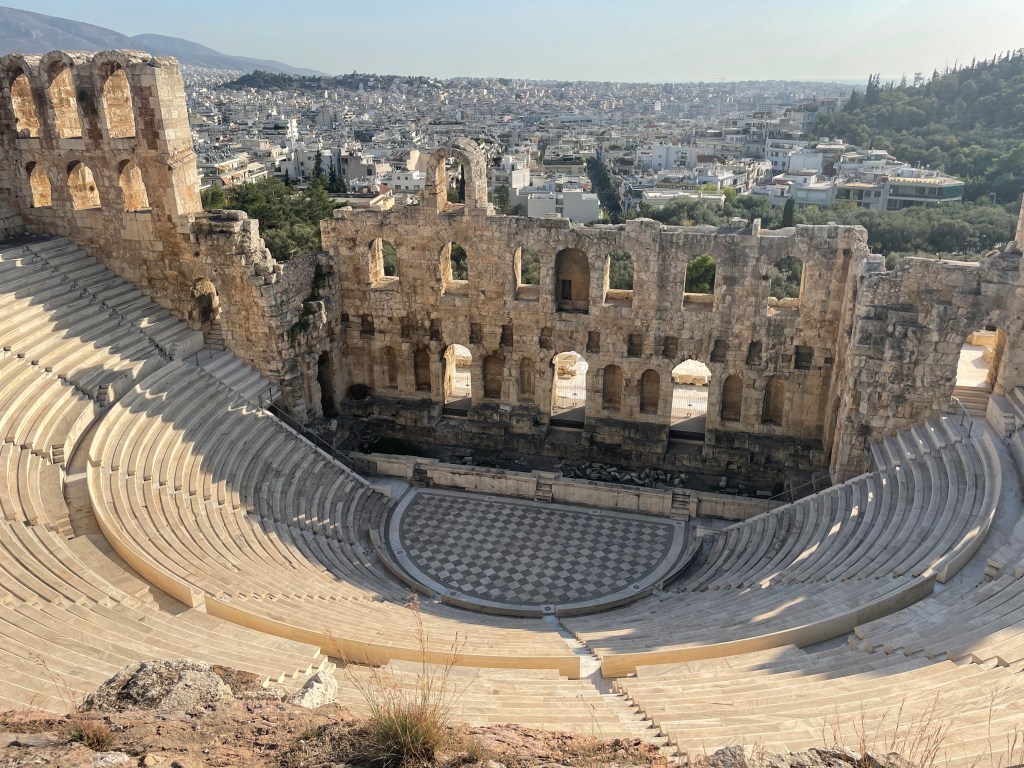
Our first stop is to look down upon the grand Odeon of Herodes Atticus, an amphitheater that would have hosted musical performances and philosophical debates in antiquity. Originally Built in AD 160 (much later than the rest of Acropolis) and renovated in 1950, it is back to hosting musicians of the present age.
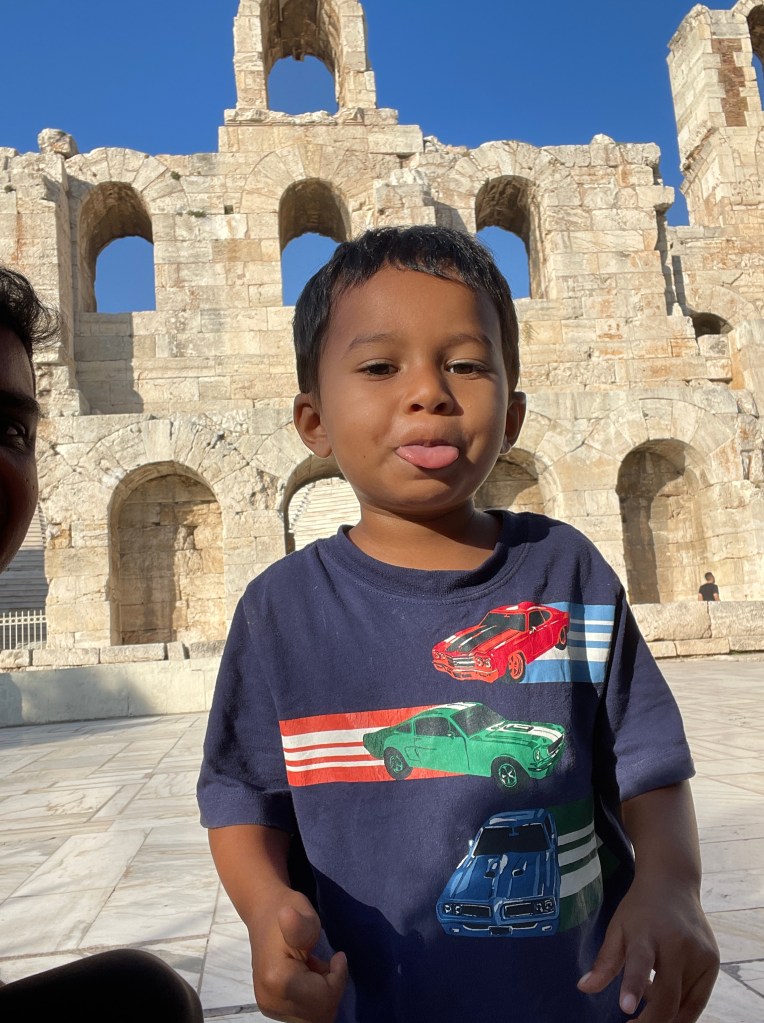
Our path winds up to the Propylea, a magnificent gateway to the Acropolis. Built in around 400 BC, its stout Doric marble columns rise up heftily and the ancient greek pilgrims, would have been suitable impressed as they huffed and puffed their way up to the Parthenon.


To the right of the Propylea, sits the temple of Athena Nike, a rather fine and delicate looking structure. The marble columns are slender and Ionic, a bit more decorative than the hefty Doric.
Nike, means victory in Greek and now of course inspires countless consumers to a life of ath-leisure and comfortable running shoes. Guards patrol the Propylea and there is no touching of ancient marble. Sadly, the tourist cannot enter any of the ancient temples.

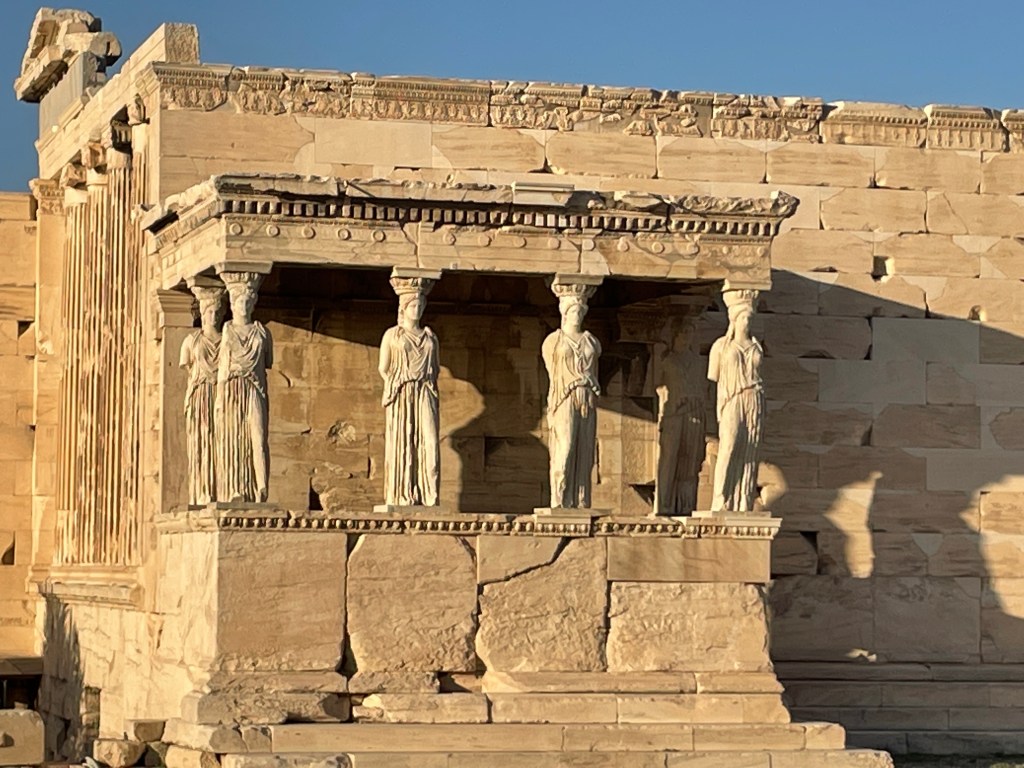
We continue our tour and stop to look at the women figurines who double up as weight bearing pillars in the Erectheion. Their once sharp features, now smudged by the acid rain of modernity.
The most famous olive tree in Greece, grows in the porch outside. Athena and Poseidon, battled out for naming rights to the city. Poseiodin struck his trident and unearthed a saltwater spring. Athena planted an olive tree and ushered in olive oil delicacies. The crowds, rather predictably chose Athena as the victor. This particular olive tree, a true descendent of that great line, I am sure feels a sense of history and perhaps its arboreal legends are similar.

Next up is a pile of marble boulders that mark the spot where there once stood a giant bronze statue of Athena. Now we see the gleaming white city of Athens, shimmering below.
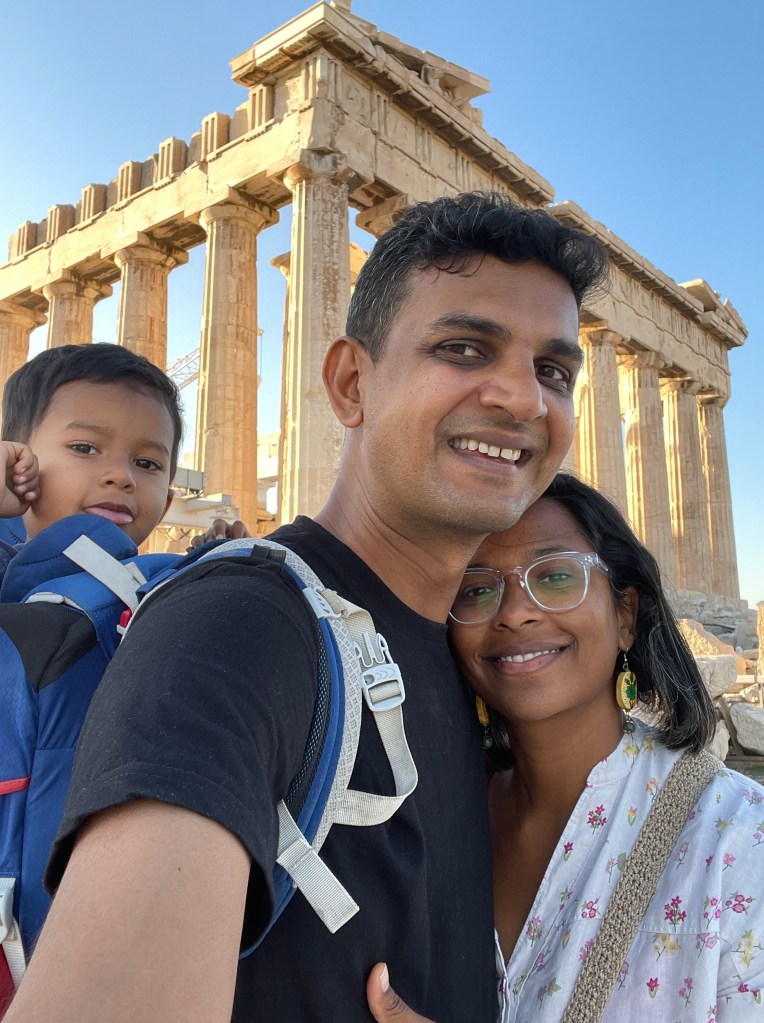
The Parthenon is the central showpiece, a symbol of democracy and Western civilization. Doric pillars rise up and the roof now is the open skies. The ancient Greeks, given to philosophy were extremely practical and aesthetically inclined engineers. Knowing that perfectly straight lines appear to sag outwards, they tilted the opposing columns ever so slightly inward. Even the columns themselves bulge in the center to counter the optical illusion of a thin waist. The architects were Kalikrates and Iktinos, overseen by the sculptor Phidias. Their little firm was quick on the job and amazingly finished their job in a decade. For all their back and forth debates the greeks appear to have been ruthlessly efficient. And no body was even whipped. Because, unlike the pyramids or the colosseum, it was all done without slave labour. Free men raised these pillars.
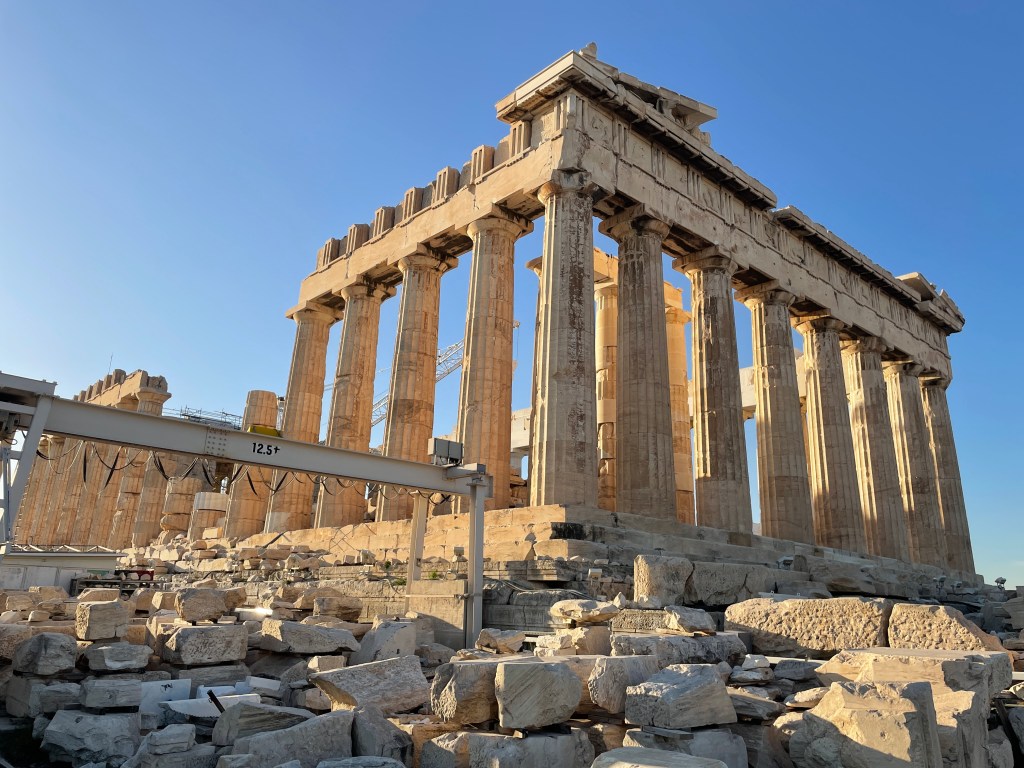
Time has truly ravaged the Parthenon. Originally dedicated to Athena Parthenos (the Virgin in ancient Greek),the early christians, conveniently appropriated the parthenon for the Virgin Mary. With monotheistic zeal, they cut away some of the more blatantly polytheistic stuff. When the Ottomans, took over in the middle ages, they built a dome and made it into a mosque. And perhaps, more surprisingly used it to store gunpowder. When the Venetians wanted to oust the Ottomans, they dropped a cannon ball into the gunpowder store and the Parthenon blew itself up. Since then its all been open air and blue skies at the top.
In 1800s, the British struck a deal with the Ottomans, and ferried away whole pillars and the finest sculptures from the rubble.Even the early 20th century attempts at restoration with iron joints did more harm than good. Now the glory must be imagined from afar.


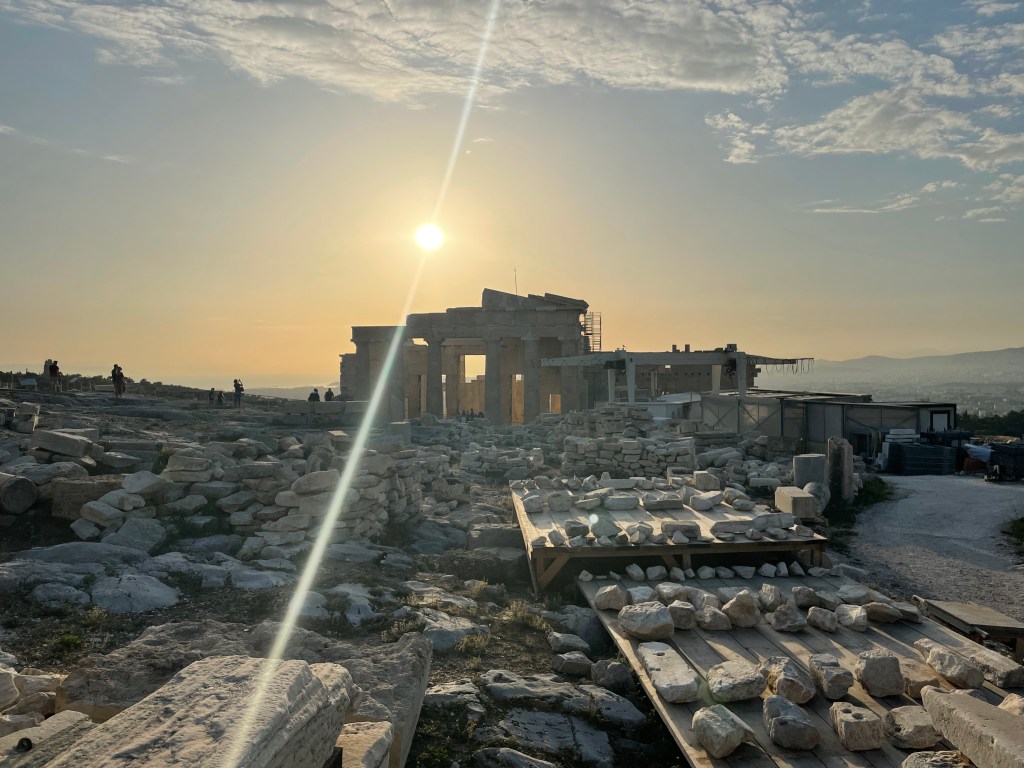
Construction scaffolding lines the face of the Parthenon and Arjun is happy to see diggers and forklifts. Archaeologists must now catalogue every fragment and attempt it piece it all back. The stuff that the British stole, must probably be redone. What took a decade originally, is now in a state of construction after 20 years. I talk to Sotiris, a wonderful guide who inspired by Indiana Jones, studies archaeology. He enlightens us with a lot of history, but is not too hopeful of seeing the renovation completed.

In the orange rays of the setting sun, the parthenon lights up, it’s marble glowing warmly. A column of sombre army men march, guns slanting upwards and lower the Greek flag with much ceremony. Every evening the flag is lowered , before the gates close and the tourists leave. When confronted by the Nazis, a brave Greek soldier preferred to wrap himself in the flag and jump to his death, rather than raise the swastika.
 Three Bears Travel