Alentejo is a landscape of open skies and dry rolling plains. Cork (an oak species) forests and olive orchards sprinkle the sparsely populated land. Lusitano horses, sheep, and beefy cattle graze freely in infinite pastures. The “porco preto” (black pig) that feeds on the fatty acorns of the Holm oak and whose meat is revered for its taste and texture is a famous export from this beautiful landscape. A few severely white-washed homes and the occasional tractor mark the presence of their caretakers.

We are in the “montado”, a landscape shaped by humans since the Neolithic period (8000 years ago). As the hunter-gatherers moved north from the coast, selectively cut down some trees, and cleared the dense Iberian forests, they settled into a more sedentary lifestyle and became what we now call the “agro-pasturalist”. They had just discovered polished stone tools and sheep were indeed a more reliable source of milk and meat.
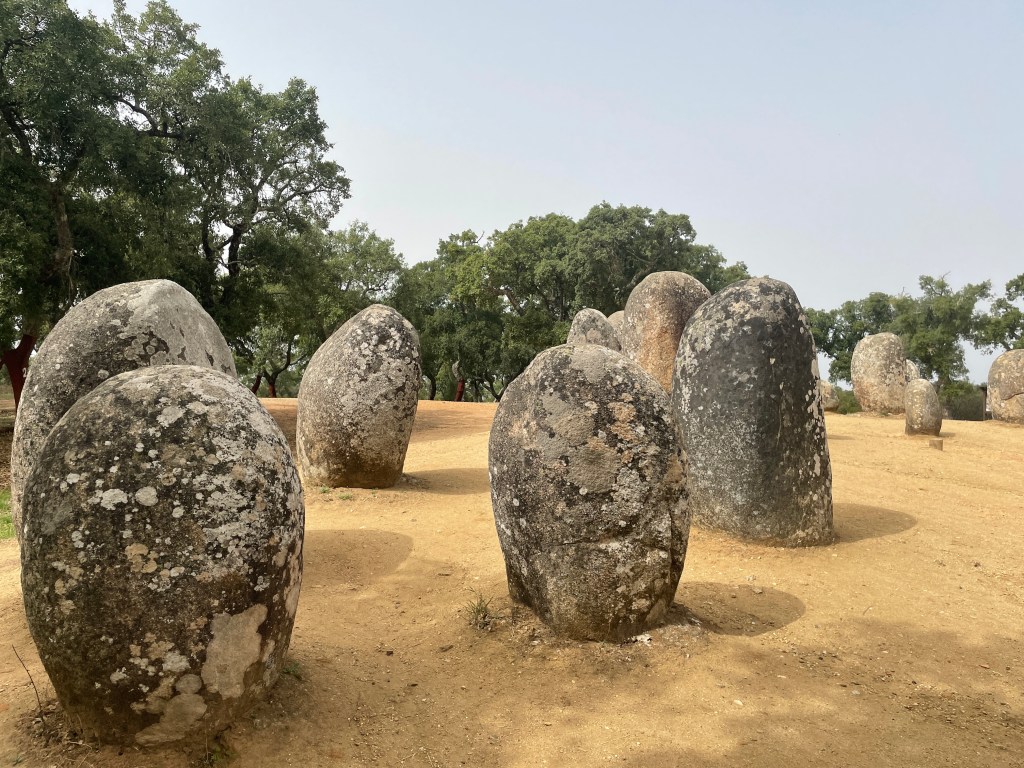
A short drive out of Evora, lies the megalithic complex of Almenders. A hundred weathered granite egg-shaped boulders lie in a rough ellipse on a gentle slope facing the East. Cork trees, with their peeled barks revealing a cinnamon core, provide the perfect backdrop. These menhirs are about 7500 years old and were built by the communities, who settled here over the course of several generations.
They dragged these naturally occurring boulders on wooden logs and maneuvered them into place using brute strength and perhaps a strong oak lever. The ellipse lies on an east-west axis and has an astronomical significance, marking the equinoxes.

The change of seasons, and the lengthening and shortening of the day would have been important clocks for these early pastoralists. The archaeologists inform us that this site marks one of the most important transitions in human history. The time when we realized that growing your own lunch is far easier than chasing it down a burrow.

Some interpret the menhirs to have a phallic shape and others argue that it is symbolic of the whole body. They agree that it was some sort of sacred place. A few stones have carvings still visible. Dhanya could spot a circle and we saw some squiggly lines. What they really meant to these people is something we ponder about.
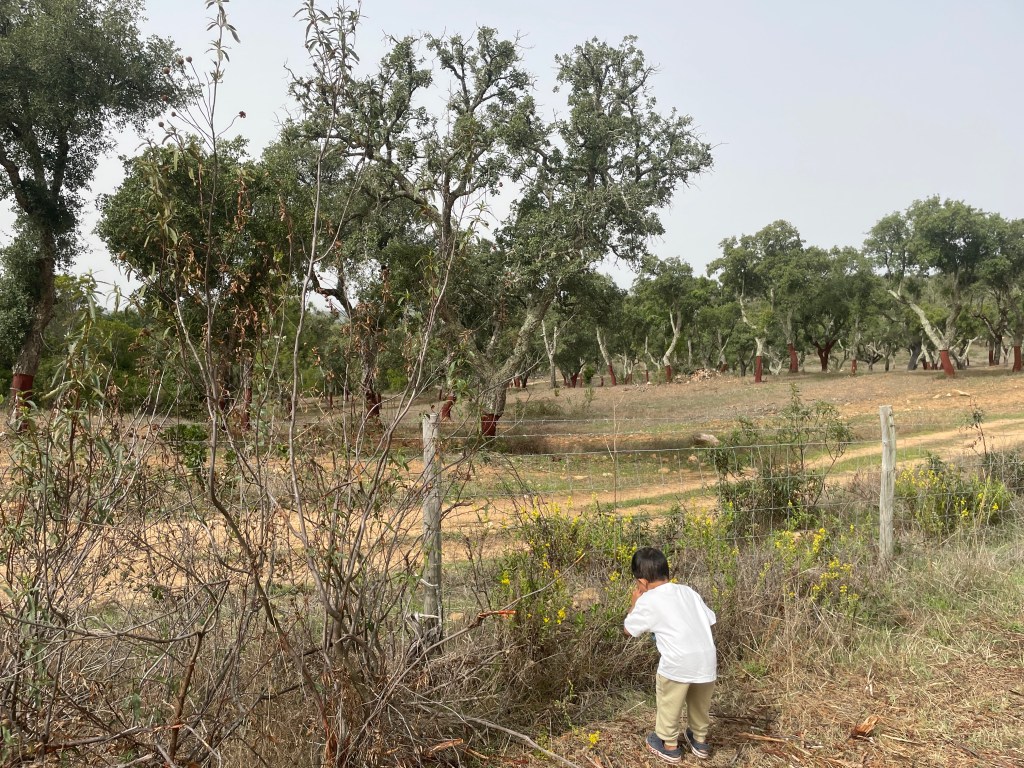
Leaning back on the cork trees, we spend the whole afternoon in the presence of these menhirs. There is an aura of peace that envelops us. A few days later, Arjun tells me that he likes the “megalithy” ancient stuff more than the other “ancient” stuff. I couldn’t agree more.

 Three Bears Travel
Very well written. Great photographs too. We got a sense of history, in a witty and personal style, as if telling a story, not in a boring way. Great
LikeLike